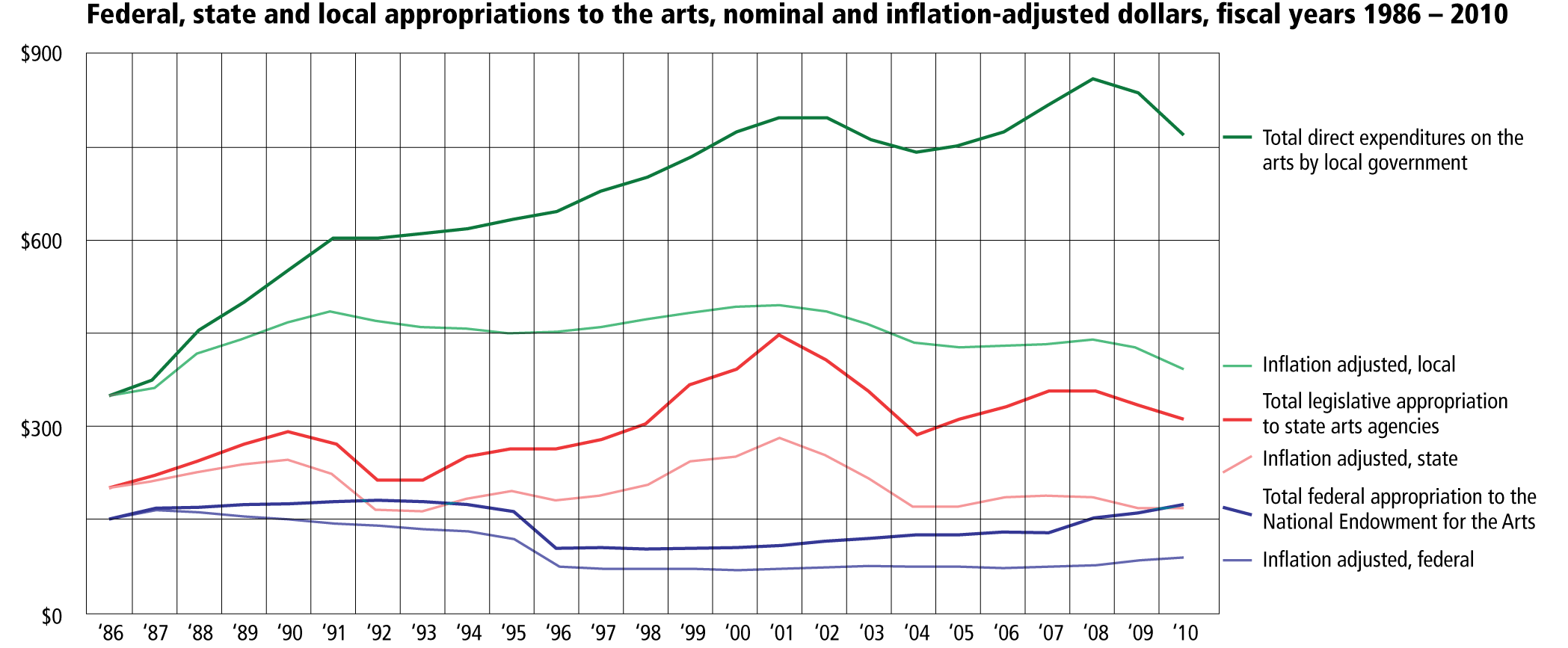
Many people may be under the impression that the economy in the last few years is to blame for the lack of arts funding. However, statistics found by Grantmakers in the Arts, the only national organization made up of both private and public funders, shows that there has actually been a steady, inflation-adjusted amount of federal funding since 1996 (graph). What is more surprising is that the NEA actually received just under $50 million more on 2009 via the $789b stimulus package. So, can the recession really be a cause in the lack of arts funding?
The vital point one must realize is not the decrease in arts funding but that over the years priority in funding for the arts has been at the very bottom of the list. If one were to look back again at the recession example, he might gain new perspective by evaluating the $50 million proportion the NEA received compared to the entire $789 billion stimulus package. That makes out to .006337%. A more viable cause to the lack of arts funding, therefore, can be found when analyzing the source of the funds.
When it comes to federal funding for the arts, or any federal funding for that matter, there is a long supply chain of cash from the government to the individual. However, each level is either run by congress or congress has high influence on decisions of where money is allocated. A typical government-to-individual funding may go like this:
-First, congress decides where government money goes. It decides an appropriate amount and distributes it among the various departments.
-Arts, or as it is categorized by government as cultural affairs, belongs in the Department of Health and Human Services (DHHS). This major agency receives the biggest amount of funding, but is also diluted with thousands of organizations remotely relevant to its title.
-Then, the DHHS distributes this to the various organizations, the amount depending on how important the organization is to the US society.
-The National Endowment of the Arts is the biggest arts organization that awards grants to selected individuals and smaller organizations.
The first question that may come to mind may be, why is the National Endowment of the Arts categorized into the Department of Health and Human Services, where organizations such as Centers for Disease Control and Prevention, National Institutes of Health, and the Health Resources and Service Administration are? The NEA website shows a list of every grant made each year and a big portion of its funds go to grants for education in the arts like Learning in the Arts for Children and Youth and Literature Fellowships: Creative Writing. Therefore, the more reasonable department it would belong in is the Department of Education. When categorized in the DHHS, it is no wonder the NEA receives such minimal amounts of funding. This leads to an important fact: the government, or republicans more specifically, views funding for the arts as non-essential.
The graph linked earlier shows that from the year 1995 to 1996, there was a drastic decrease in arts funding. The year 1995 was also the first time in eight years the republicans gained majority seats in congress. It was not until 2009 when the democratic part gained majority power in congress, which, as stated earlier, was also when the stimulus bill was package was released. Republican views generally wrap around the conservative ideal, whereas art is attributed to a liberal ideal. This contradiction has a long trace of evidence, stemming back to former President Ronald Reagan (a republican) and his attempts to abolish the NEA. Because modern art is generalized to include open-mindedness, many creations become highly criticized by republicans and leads to efforts in eliminating funding.
In a society where freedom of speech and self-expression is not only accepted, but also encouraged, it is unreasonable for government members representing those people to deny them of their rights by creating a lack of funds. Every component of the arts is an important factor in what makes the US culture and society. If higher measures were taken, first by placing the NEA in the right department, then by increasing arts funding, there would be a more appreciative view on the arts.
References:
"Contract, Grant and Loan Programs." Recovery.gov - Tracking the Money.
Web. 16 Aug. 2011.
Han, Angela. "Public Funding for the Arts: 2010 Update | Grantmakers in the Arts." Grantmakers in the Arts. Web. 15 Aug. 2011.
"Grants: Recent Grants." National Endowment for the Arts. Web. 15 Aug. 2011.
Quigley, Margaret. "The Mapplethorpe Censorship Controversy." PublicEye.org - The Website of Political Research Associates. Web. 15 Aug. 2011.
"Senate Statistics." United States Senate. Web. 15 Aug. 2011.
"The Stimulus Plan: A Detailed List of Spending." ProPublica. Web. 15 Aug. 2011.
United States. Catalog of Federal Domestic Assistance. CFDA. Web. 15 Aug. 2011.
United States. Grants. Arts. Web. 15 Aug. 2011.

This comment has been removed by a blog administrator.
ReplyDelete