Travis Korte at The Huffing Post makes a very interesting point regarding the lack of art funding in his article Obama's Arts Budget Cuts Address National Endowment's Weakness. He calls out the art advocates to "abandon the federal funding model", to "let the art budget die", to show that we Americans are sacrificing the tree for the forest - the economy. Proving his point, he uses the privately funded Smithsonian exhibition as an example, and argues that by not funding the art, government invests in long-term federal projects and eventually, there would be a convoluted path somewhere that can help the art get funded.
I personally disagree. I actually may agree with him to some extent - where he says that we should not only rely on federal fund; however, letting the art budget die is like committing suicide.
His first point is that by not funding the art, government invests in long-term federal projects with more benefits for the whole system: "federal projects that make it easier to do anything also make it easier to do art." Easier to do art, but to what extent? As Kim, another author of this blog, finds out, art has always been the "very bottom priority". Investing "the means but not the ends" helps nothing when the society never considers art as one of the ends. In his article, he automatically assumes that "there are countless factors [..] that play a much larger role in determining what gets funded than does the federal arts budget." I would agree only if I would be shortsighted and my perspective would be limited from libertarian economist's viewpoint. From art-lover's viewpoint, art helps create the culture and heal the society (there is already a blog discussing that), and it simply not fair to prefer economy over culture.
His second point, abandoning the NEA is not the same as abandoning the art, is also flawed. Other than NEA, the government has never had any other actions to show that they support the art. While the art is so important, should government show some support so that community won't lost their belief of a better culture?
Source:
Korte, Travis. "Obama's Arts Budget Cuts Address National Endowment's Weakness."Breaking News and Opinion on The Huffington Post. 4 Mar. 2011. Web. 02 Sept. 2011. <http://www.huffingtonpost.com/travis-korte/obamas-arts-budget-addres_b_831658.html>.
Friday, September 2, 2011

Thursday, September 1, 2011
Republican Regulated
Many people may be under the impression that the economy in the last few years is to blame for the lack of arts funding. However, statistics found by Grantmakers in the Arts, the only national organization made up of both private and public funders, shows that there has actually been a steady, inflation-adjusted amount of federal funding since 1996 (graph). What is more surprising is that the NEA actually received just under $50 million more on 2009 via the $789b stimulus package. So, can the recession really be a cause in the lack of arts funding?
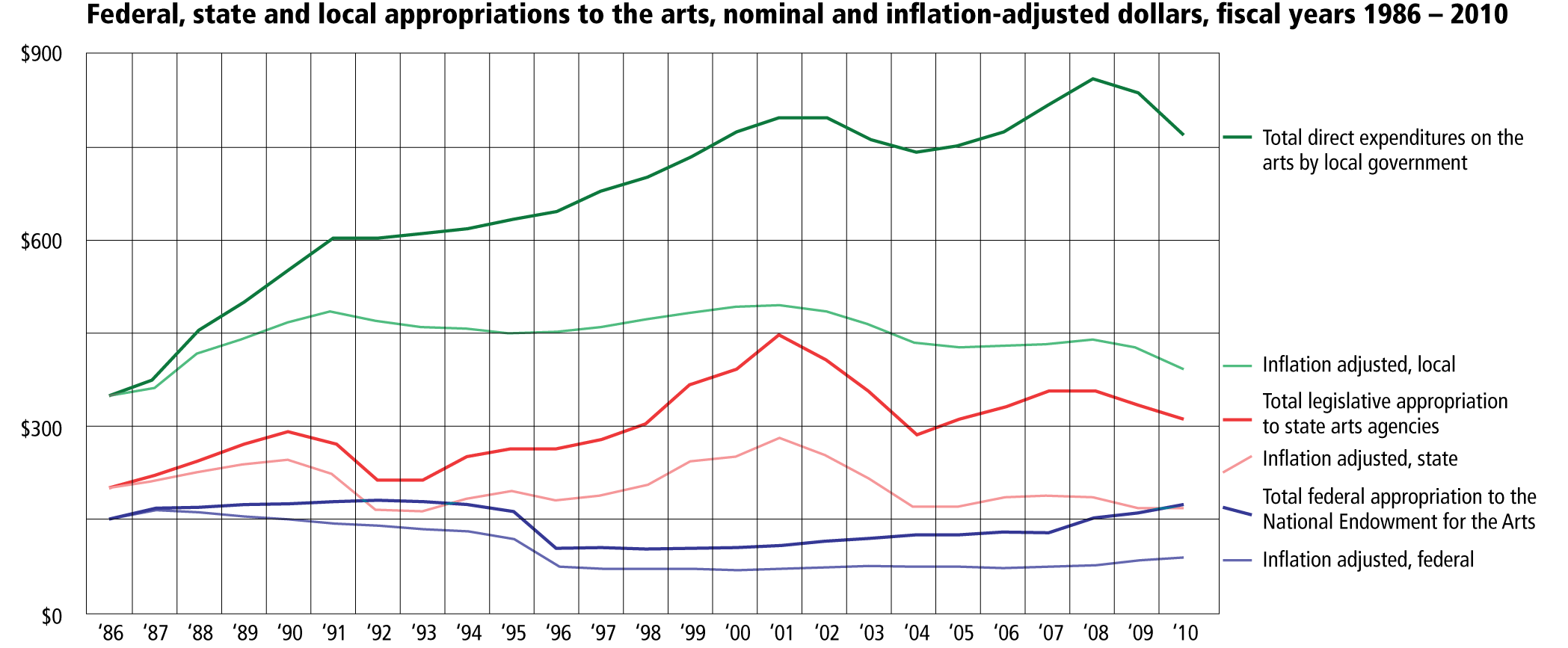
The vital point one must realize is not the decrease in arts funding but that over the years priority in funding for the arts has been at the very bottom of the list. If one were to look back again at the recession example, he might gain new perspective by evaluating the $50 million proportion the NEA received compared to the entire $789 billion stimulus package. That makes out to .006337%. A more viable cause to the lack of arts funding, therefore, can be found when analyzing the source of the funds.
When it comes to federal funding for the arts, or any federal funding for that matter, there is a long supply chain of cash from the government to the individual. However, each level is either run by congress or congress has high influence on decisions of where money is allocated. A typical government-to-individual funding may go like this:
-First, congress decides where government money goes. It decides an appropriate amount and distributes it among the various departments.
-Arts, or as it is categorized by government as cultural affairs, belongs in the Department of Health and Human Services (DHHS). This major agency receives the biggest amount of funding, but is also diluted with thousands of organizations remotely relevant to its title.
-Then, the DHHS distributes this to the various organizations, the amount depending on how important the organization is to the US society.
-The National Endowment of the Arts is the biggest arts organization that awards grants to selected individuals and smaller organizations.
The first question that may come to mind may be, why is the National Endowment of the Arts categorized into the Department of Health and Human Services, where organizations such as Centers for Disease Control and Prevention, National Institutes of Health, and the Health Resources and Service Administration are? The NEA website shows a list of every grant made each year and a big portion of its funds go to grants for education in the arts like Learning in the Arts for Children and Youth and Literature Fellowships: Creative Writing. Therefore, the more reasonable department it would belong in is the Department of Education. When categorized in the DHHS, it is no wonder the NEA receives such minimal amounts of funding. This leads to an important fact: the government, or republicans more specifically, views funding for the arts as non-essential.
The graph linked earlier shows that from the year 1995 to 1996, there was a drastic decrease in arts funding. The year 1995 was also the first time in eight years the republicans gained majority seats in congress. It was not until 2009 when the democratic part gained majority power in congress, which, as stated earlier, was also when the stimulus bill was package was released. Republican views generally wrap around the conservative ideal, whereas art is attributed to a liberal ideal. This contradiction has a long trace of evidence, stemming back to former President Ronald Reagan (a republican) and his attempts to abolish the NEA. Because modern art is generalized to include open-mindedness, many creations become highly criticized by republicans and leads to efforts in eliminating funding.
In a society where freedom of speech and self-expression is not only accepted, but also encouraged, it is unreasonable for government members representing those people to deny them of their rights by creating a lack of funds. Every component of the arts is an important factor in what makes the US culture and society. If higher measures were taken, first by placing the NEA in the right department, then by increasing arts funding, there would be a more appreciative view on the arts.
References:
"Contract, Grant and Loan Programs." Recovery.gov - Tracking the Money.
Web. 16 Aug. 2011.
Han, Angela. "Public Funding for the Arts: 2010 Update | Grantmakers in the Arts." Grantmakers in the Arts. Web. 15 Aug. 2011.
"Grants: Recent Grants." National Endowment for the Arts. Web. 15 Aug. 2011.
Quigley, Margaret. "The Mapplethorpe Censorship Controversy." PublicEye.org - The Website of Political Research Associates. Web. 15 Aug. 2011.
"Senate Statistics." United States Senate. Web. 15 Aug. 2011.
"The Stimulus Plan: A Detailed List of Spending." ProPublica. Web. 15 Aug. 2011.
United States. Catalog of Federal Domestic Assistance. CFDA. Web. 15 Aug. 2011.
United States. Grants. Arts. Web. 15 Aug. 2011.
Importance of the Arts
The arts, including visual arts, theatre, music, film, and dance have been a large part of society since the beginning of time. However recently due to cultural, and economical changes the funding has been cut for many arts programs. The importance of the arts is beginning to dwindle due to cuts and have made an effect on the communities, on schools, and on individual artists.
The importance of arts has recently become overlooked. They play a large role in every person’s life. Listening to a song on the radio, or watching a movie is involvement with the arts. It is important that we are reminded of the necessity of the arts in our schools, in our cultures, and in our communities. The National Assembly of State Arts Agencies (NASAA) explains the importance of the arts and why the government needs to support them more financially. NASAA discusses the economic effect that the arts have explaining, “The arts create jobs and produce tax revenue [...] “The arts have been shown to be a successful and sustainable strategy for revitalizing rural areas, inner cities and populations struggling with poverty.” They also explain the importance of the arts in education stating, “The arts foster young imaginations and facilitate children’s success in school. They provide the critical thinking, communications and innovation skills essential to a productive 21st-century work force.” The arts create civic catalysts through “a welcoming sense of place and a desirable quality of life. The arts also support a strong democracy, engaging citizens in civic discourse, dramatizing important issues and encouraging collective problem solving.” Finally NASAA explains the importance of cultural legacies through the arts saying that “The arts preserve unique culture and heritage, passing a state’s precious cultural character and traditions along to future generations.”
The place that cuts have had the most effect is in education. States have made extreme budget cuts not only to the arts but to public schools as well. The state of Pennsylvania made a $900 million cut to K-12 education (Davidson). The school systems then are forced to make teacher cuts and the first ones to go are in the art departments. The core classes such as math, English, History, and Science are the priority and the arts are seen as extra curricular classes that are unnecessary. In a CNN politics reports Christie Praeger, a second grade teacher in the Bronx, explains, “I don't disagree that reading and math are the most important aspects of education. But compromising other subjects... causes us to teach only for the test," Praeger said. If a student's talents lie in art, or music or science, they lose out, she said. "And schools can't force [teachers] to be creative in their approach, especially if all that matters is a test score." Roger Crutchfield, a principal at a high school in Oklahoma states “Cutting staff today means avoiding anything that has to do with reading and math”.
The awareness of the importance of the arts needs to be more present in our daily lives especially when it comes to the importance of a child’s education, and development. Until this problem is solved the cuts are going to continue to grow and it is important that as a community we continue to involve the arts in our lives.
Davidson, Samuel. "Massive Cuts to Education in Pennsylvania Budget." World Socialist Web Site. Web. 25 Aug. 2011.
Van Harken, Joseph. "Budgets Cut Student Experience - Page 2 - CNN." Featured Articles from CNN. 20 Aug. 2003. Web. 25 Aug. 2011.
Friday, August 26, 2011
A Changing Culture
Funding for the arts has been a debated topic in the United States for years. From the refusal to publish the Guggenheim commissioned project by
This cultural shift towards a lesser view of the arts and their impact on society can help sway the government’s decision on funding. The sway becomes an issue within the arts community because the government holds the key to a major piece of arts and arts education funding. But, with the many benefits of the arts and arts education, why is it that the general public seems to overwhelmingly support the cutting arts funding? A cultural shift away from the arts seems to be the leading culprit for the annual pointing of the finger at the arts during budget discussions. With "rapid advances in  c has more opportunities to enjoy and support the arts, but according to the latest report by the National Endowment for the Arts, "there has been a long-term pattern of decline since 1985." This pattern seems to be starting a cycle of decline in interest for the arts. The NEA has proposed that the drop in interest and participation has a strong correlation with involvement in arts education. According to the latest report, the percentage of 18-year-olds who have received some form of childhood arts education has dropped nearly 15% over the last 28 years. This drop seems to be contributing to the shifting view on arts funding and is placing the arts community in a sort-of catch-22 situation. As funding drops for arts education, fewer Americans will become involved in the arts and as fewer Americans become involved in the arts, they will continue to point the finger towards the arts funding whenever a budget cut is necessary. This finger pointing was shown in a 2010 PEW study on residents of five states which are in economic stress. The study claimed that in all five states, which included Florida, New York and California, the residents supported, by a majority ranging from 57% to 71%, raising taxes to maintain education and Medicaid funding, but would rather the taxes be directed at the "other guy." These "other guys" were groups that the residents did not identify with, ranging from drinkers, smokers and corporations. With the consistent decrease in arts education participation, the number of people who can count arts programs as the "other guy" continues to grow.
“Public attitudes and fiscal realities in five stressed states” PEW center of the states, October 2010.
“Arts Education in America: What the declines mean for arts participation” NEA, February 2011.
Subscribe to:
Comments (Atom)